Strategic Geopolitical Analysis for Boards and Compliance Teams.

Drawing on over 20 years’ experience in International Relations, I work with clients who need to understand how geopolitical competition translates into regulatory risk and business strategy. 

Dr Paul Hayman, LL.B (Hons), MA, PhD, FHEA
WHAT I DO

I help organizations anticipate regulatory shifts before they become compliance crises. My work focuses on three areas:

Sanctions & Export Control Forecasting – Identifying which sectors, entities, and technologies will face new restrictions, and when.

China-West Strategic Analysis – Assessing how US-China competition will reshape investment screening, supply chain security, and market access.

Board-Level Scenario Planning – Translating geopolitical developments into actionable strategic options for leadership teams.

I provide the critical layer of strategic intelligence that sits upstream of your legal and compliance functions.


Deliverables include:

  • Regulatory trajectory briefings (12-18 month forecasts)
  • Board-level geopolitical risk assessments
  • Scenario planning workshops for executive teams
  • Transaction-specific geopolitical due diligence
  • Quarterly strategic intelligence updates
Selected insights
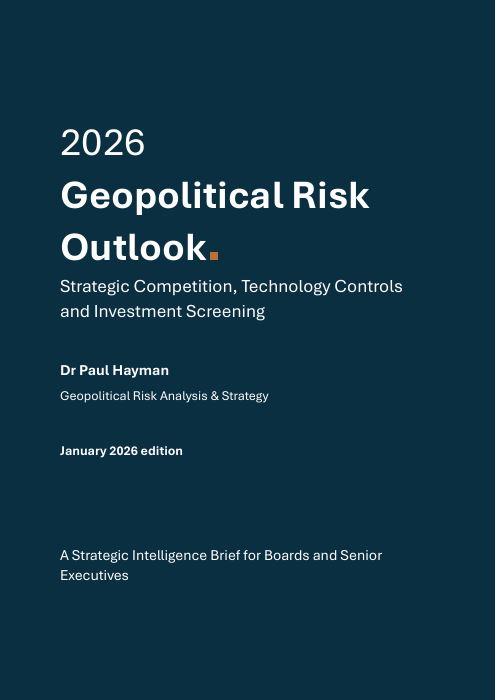
2026 GEOPOLITICAL RISK OUTLOOK

Strategic competition is making regulatory trajectories more predictable. When national security dominates economic efficiency, the direction becomes clear—even as implementation remains complex.

Key forecasts: Technology export controls expand predictably through AI chips, cloud computing, and biotech. Investment screening converges across allied jurisdictions with 18-24 month approval timelines. Secondary sanctions target bypass hubs in the Gulf. Supply chain security requirements accelerate across critical technologies.

The outlook provides regulatory timeline forecasts through 2030 with probability assessments for each trajectory. Includes analytical frameworks: Technology Criticality vs. China Dependency Matrix, Scenario Probability Assessment (2025-2027), Comparative Investment Screening Regimes, Leading Indicators Dashboard, and Priority Actions by Risk Tolerance.

Click here to download.

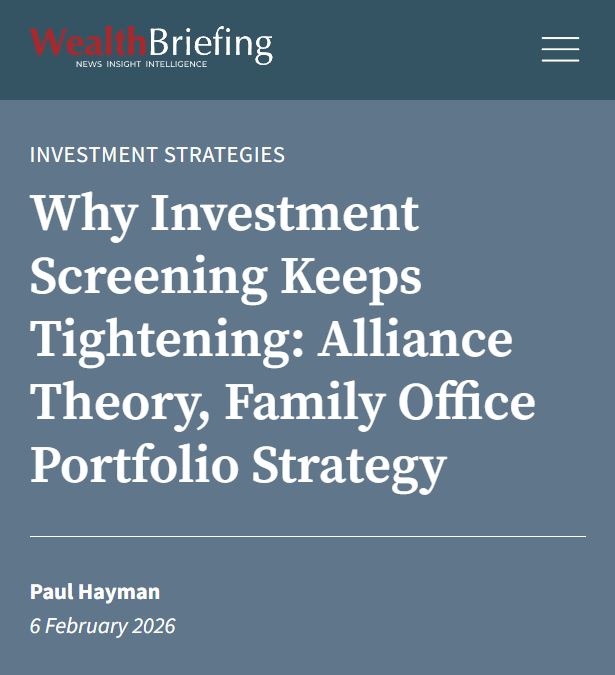
Why Investment Screening Keeps Tightening: Alliance Theory, Family Office Portfolio Strategy

The application of alliance theory from international relations to explain why investment screening regimes inevitably expand in scope and membership, and what this means for family office cross-border portfolio management.

Click here to access.

Geopolitical Scenario Planning and the Board

Boards are applying a risk-monitoring toolkit to a strategy-shaping challenge. They often review quarterly geopolitical updates, nod at supply chain vulnerabilities, track regulatory changes — then move to the next agenda item. Meanwhile, the strategic decisions that determine whether their companies thrive or stumble under geopolitical uncertainty go unmade.

The problem isn’t insufficient information. It’s misclassification. Boards tend to treat geopolitical dynamics as risks to monitor when, in fact, they are structural uncertainties to govern. Risk committees can track compliance. They cannot decide whether to build parallel supply chains, choose between competing regulatory spheres or time major capital commitments when the future genuinely splits into different paths.

Click here to access.

Contact

For inquiries about advisory work or speaking engagements:

paul@haymanadvisory.com

www.linkedin.com/in/dr-paul-hayman


 Expert Consultant

© 2026 Hayman Advisory